



She came home with her shoes half-off and her tie already missing.
“Papa,” she said, dropping her bag like it had no bones. “I need to come up with ideas for school.”
I was mid-email. Half a thought away from a meeting.
“Ideas for what?” I asked, still looking at the screen.
“To save water,” she said. “We have to showcase it. Best idea goes in the school newsletter.”
“Okay,” I said. “Let’s talk about it after dinner.”
She didn’t argue. She just nodded.
“It’s not a big deal,” she said, already turning away.
Then she paused and added:
“Let’s ask AI.”
✳ The new default
That sentence has become a new kind of punctuation in our home. Not dramatic. Just normal.
And that’s what makes it worth noticing.
Because what she really said was: we’re not limited by what we know.
There’s now a household utility that can help with everything from trip planning to homework explanations to school project ideas. It removes a lot of the friction that makes family life feel heavier than it needs to be. You don’t have to hold everything in your head. You don’t have to always “know.” You can move from uncertainty to action quickly.
It’s a genuine upgrade.
⚠ The catch
Upgrades change behaviour. And they change expectations.
When children grow up in a house where answers are always available, they start to treat the world like a system that should respond immediately. If you don’t know something, it’s not a dead end anymore. It’s just a query. That can be great. It makes kids more willing to ask. More willing to explore. Less embarrassed by not knowing.
But learning has never been only about answers. It’s about building the muscle required to reach them: patience, effort, and the ability to sit with uncertainty long enough for a thought to form. If every question can be resolved instantly, kids can start skipping the part that actually changes them. They can confuse speed with understanding. Output with insight. Confidence with truth.
So the parenting job quietly shifts.
Parents aren’t “the database” anymore. But we also can’t outsource judgement.
What we have to protect isn’t information. It’s the learning loop.
🧭 Blueprint first
I’ve started to think of it like this: AI is brilliant at filling gaps. It can widen the search space. It can help explore edge cases that a tired human mind would miss on a Tuesday evening. It can turn a rough idea into something structured and presentable.
But the blueprint should still be ours — and, more importantly, hers.
Because the real goal isn’t to raise kids who can summon answers. It’s to raise kids who can generate ideas and then strengthen them.
So we’re trying to introduce a sequence at home:
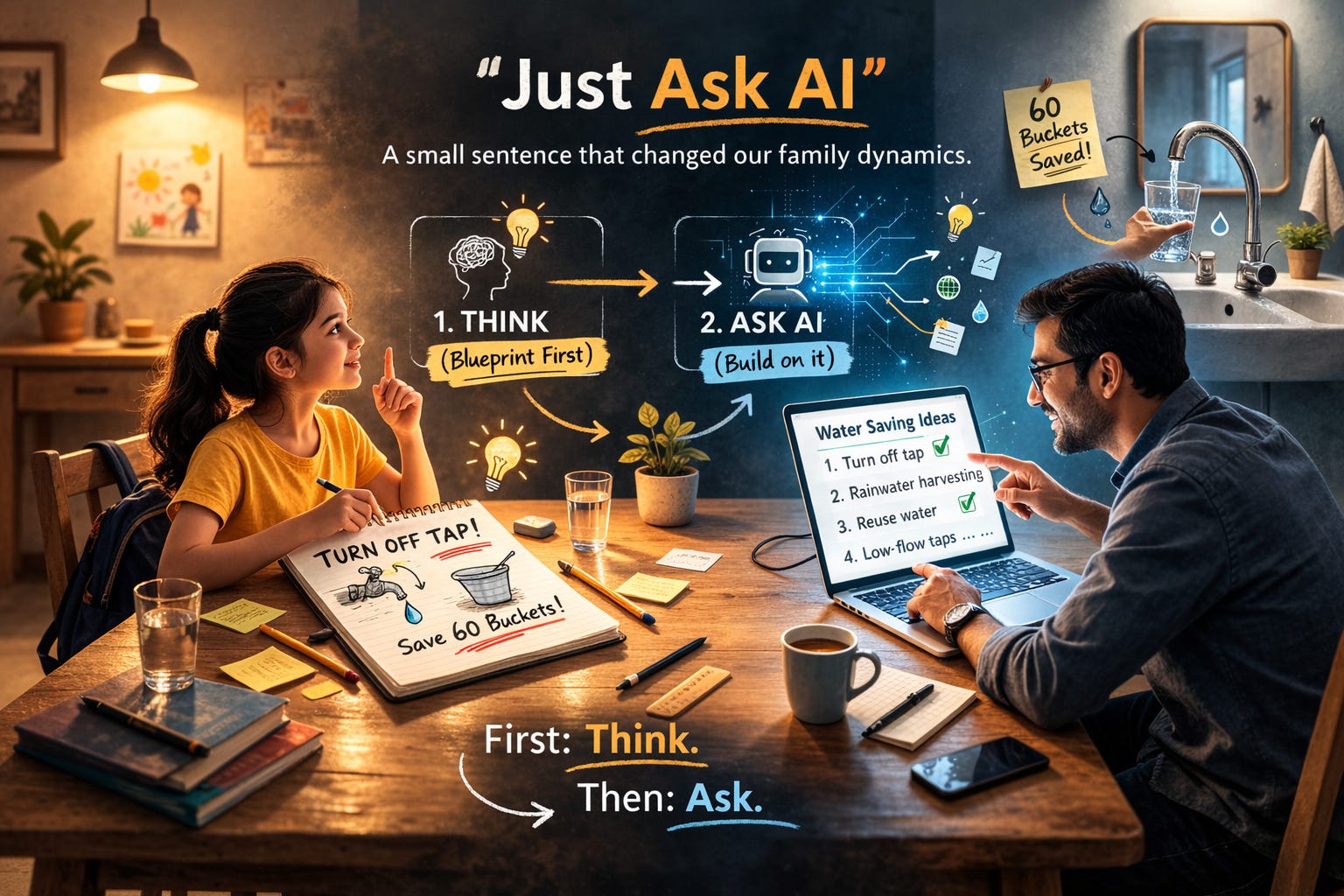
Blueprint first. AI second.
Think first. Draft something. Make a guess. Try an idea.
Then ask AI — not to replace thinking, but to improve it.
If AI is the multiplier, we still need to supply the signal.
🪑 Back at the table
After dinner, I found her at the table with a pencil and a serious face.
“Alright,” I said, sitting down. “Tell me what you’ve got.”
She didn’t hesitate.
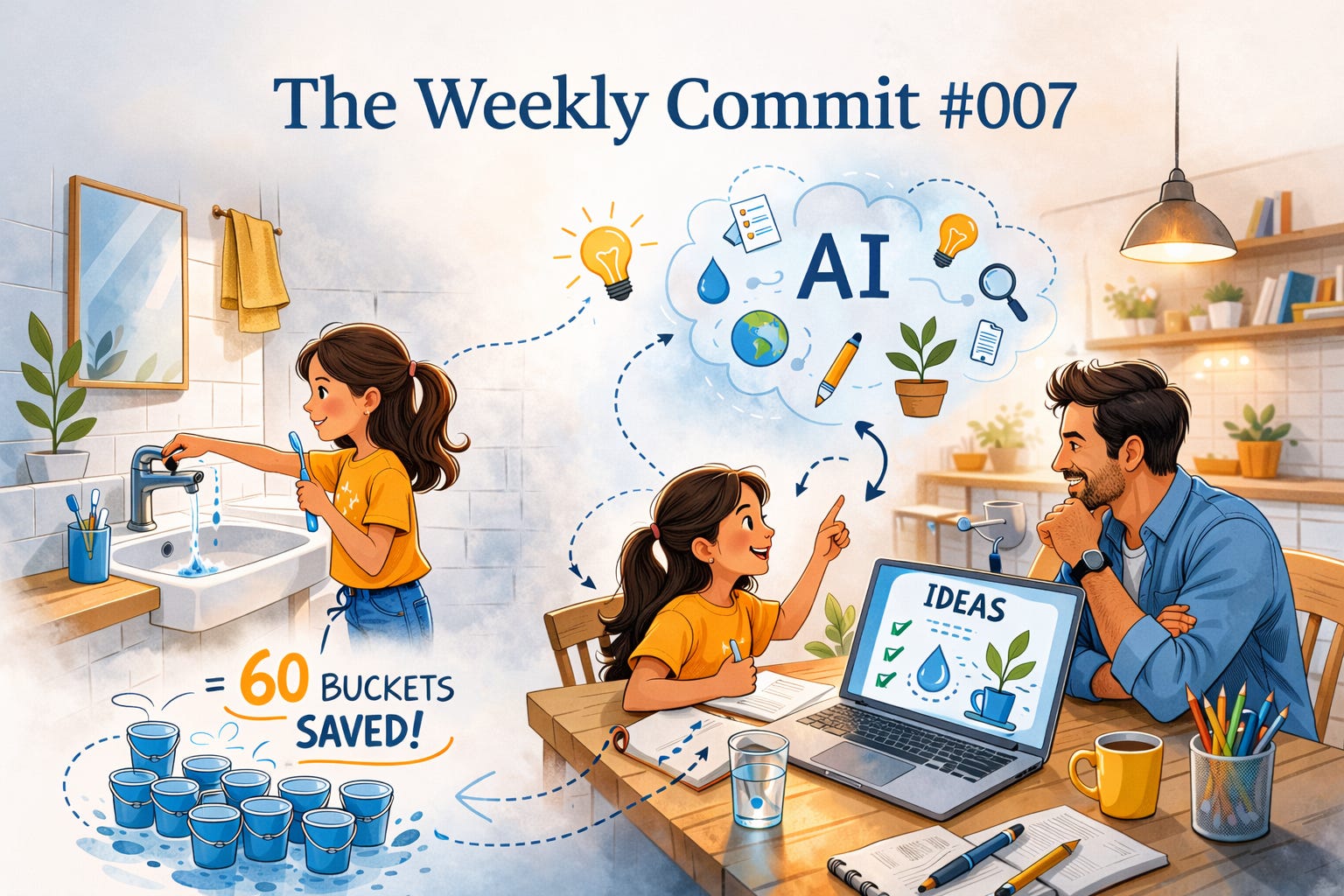
“While brushing your teeth,” she said, “you turn off the tap. That saves loads of water — like sixty buckets.”
I smiled. “That’s a great idea.”
She looked proud — properly proud — the kind you can’t outsource.
Then I said, “Now we ask AI. Not for the idea… for more.”
She leaned in. “More ways?”
“To make your idea stronger,” I said. “To learn how much it saves. To find examples. To see what else we missed.”
She nodded slowly, like the sequence finally clicked.
First: think.
Then: ask.
📌 Commit
AI gives families infinite answers. Our job is to protect the part that still matters: original thinking, patience, and judgement.
On to the next commit.


